Sale!
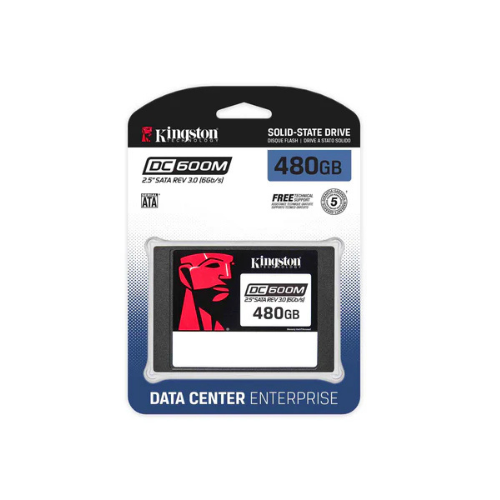
Kingston DC600M-480G 2.5” SATA Enterprise SSD
$ 92.28
- Estimated Delivery : Up to 5 business days
- Free Shipping & Returns :
Kingston DC600M 480 GB Enterprise SATA SSD Overview The Kingston DC600M Series are fourth-generation, mixed-use enterprise SATA 3.0 SSDs delivering consistent latency and reliability for data center, system integrator, and cloud service workloads. The 480 GB model combines 3D TLC NAND with on-board power-loss protection to safeguard data against unexpected outages and ensure drive re-initialization on next power-up. Key Features 2.5 in form factor with SATA Rev. 3.0 (6 Gb/s) interface, backward compatible with SATA Rev. 2.0 3D TLC NAND for high density and endurance On-board power-loss protection via hold-up capacitors DRAM cache for sustained performance Designed for mixed-use server workloads and RAID environments Capacities from 480 GB up to 7.68 TB Optimized for low and consistent I/O latency and quality of service (QoS) Enterprise SMART monitoring and advanced wear-leveling algorithms Specifications Attribute Specification Form Factor 2.5 in Interface SATA Rev. 3.0 (6 Gb/s), backward compatible with SATA Rev. 2.0 NAND Type 3D TLC DRAM Cache Yes Power-Loss Protection Yes (hold-up capacitors) Capacities 480 GB, 960 GB, 1.92 TB, 3.84 TB, 7.68 TB Performance (480 GB Model) Metric Value Sequential Read Up to 560 MB/s Sequential Write Up to 470 MB/s Steady-State 4 K Random Read Up to 94,000 IOPS Steady-State 4 K Random Write Up to 41,000 IOPS QoS Latency (99.999% Read/Write) 180 µs / 110 µs Typical Latency (Read/Write) < 200 µs / < 30 µs Endurance & Reliability Endurance (TBW): 876 TB written over drive lifetime DWPD Rating: 1 DWPD over 5 years; 1.66 DWPD over 3 years Enterprise SMART monitoring for wear leveling, life remaining, temperature, and usage statistics Static and dynamic wear-leveling algorithms
Related products
-
WD BLACK SN7100 SSD 500GB
$ 96.04